Local guidesNorth County San DiegoOceanside
Oceanside
Oceanside is a beach city in North San Diego County and the most populous city in the North County region, with 174,068 residents at the 2020 census.
Where is Oceanside, and what is it like?
Oceanside sits on the Pacific coast in the North County part of San Diego County. At the 2020 census it had 174,068 residents, the most of any city in the North County region. The city covers 42.2 square miles, of which 41.2 are land and 0.9 are water. Drive north on Interstate 5 and Oceanside is the last city before Orange County. It is roughly as far from Aliso Viejo as it is from downtown San Diego. Together with Carlsbad and Vista, it forms what people in the area call a tri-city area.
The climate is mild and semi-arid, softened by ocean winds and the cool currents off the shore. Average highs run from 64 to 77 degrees Fahrenheit, and average lows from 45 to 64. The beaches have one steady problem. Erosion has worn some of them down to a thin strip of sand between the water and the main road. In 2025 a program called RE:BEACH worked to add sand back, a process known as beach nourishment.
How did Oceanside begin?
The first people here were the Luiseño, who also go by the name Payomkawichum. They lived along the San Luis Rey River at a place they called Tacayme. Villages in that stretch included Qée'ish, also written Keish, in the area of the later mission, and Wiyóoya at the mouth of the river. The first European explorers came through in 1769. The Portolà expedition visited the village of Keish that year, on the banks of the river.
The Spanish founded Mission San Luis Rey de Francia in 1798, and the village of San Luis Rey grew up around it. Fermín de Lasuén founded it, and it was the ninth and last mission he established. It became the largest of all the California missions, which earned it the nickname King of the Missions. The oldest pepper tree in California was planted in its courtyard. Early in the 19th century, farming and grazing began to change the landscape of what would become Oceanside.
Then the mission system came apart. After the Mexican secularization act of 1833, the missions passed from the Franciscan Order to the Mexican government. Padre Antonio Peyrí had run San Luis Rey for 34 years when soldiers forced him out in late 1833. Captain Pablo de la Portillà took over as administrator, and relations with the Luiseños got steadily worse. In 1835 they refused to work for him, a standoff that is still remembered. The mission and its community declined from there.
How did Oceanside become a city?
After the United States took California, the old mission lands were developed into an oceanfront resort, and the community's name slowly turned into Oceanside. Andrew Jackson Myers, an emigrant from Illinois, moved onto the land that became the original townsite in 1882. The federal government issued a patent for it in 1883. Oceanside was incorporated on July 3, 1888. City hall now stands on the former Myers homestead. The first Oceanside Pier was built the same year, 1888, and the current one is the sixth.
The town post office holds a painted mural called Air Mail. Elsie Seeds painted it in 1937 under a federal program that commissioned murals for post offices from 1934 to 1943. Oceanside has kept its reputation as a vacation home market. In the 2010s, several mid-rise and high-rise housing and lodging projects were finished downtown, with more planned. In 2021 two large Hyatt resorts opened, bringing more visitors to the city.
Who lives in Oceanside?
The 2020 census counted 174,068 people, up from 167,086 in 2010. There were 63,032 households, with an average household size of 2.74. About 29.8 percent of households included children under 18. The median age was 39.3 years, and 17.6 percent of residents were 65 or older. Of the occupied homes, 58.6 percent were owner-occupied and 41.4 percent were rented. Hispanic or Latino residents of any race made up 36.4 percent of the population.
A 2023 estimate from the Census Bureau put median household income at $93,724 and per capita income at $43,094. About 8.1 percent of the population was below the poverty line, and about 4.5 percent of families.
What is there to see and do in Oceanside?
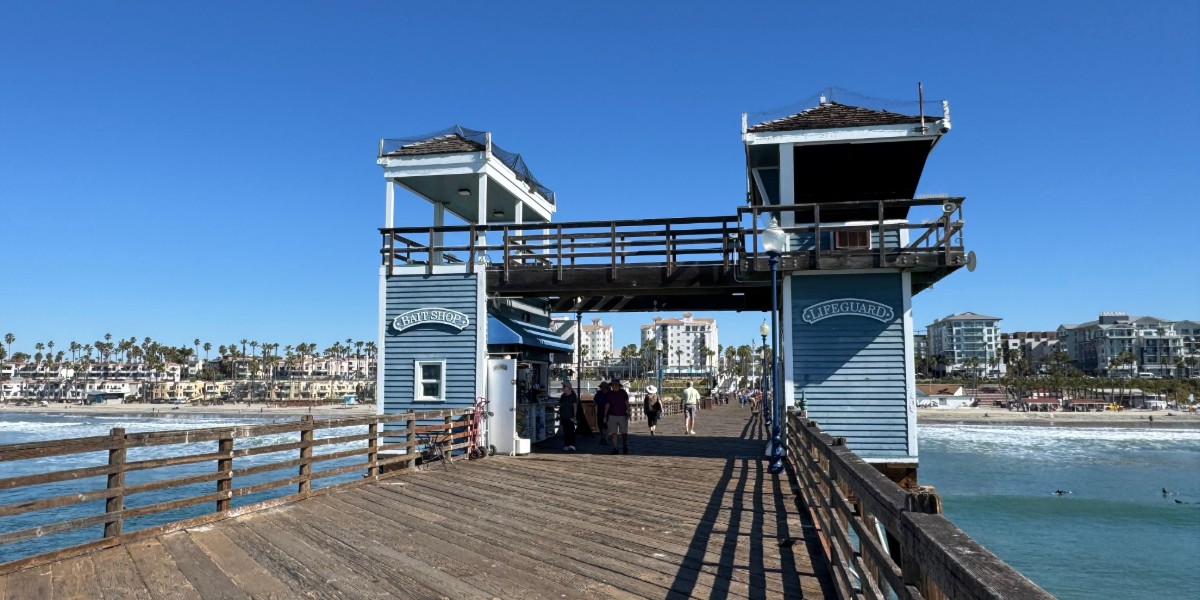
The Oceanside Pier is the landmark. At 1,942 feet it is one of the longest wooden piers on the western United States coastline. Fishing from it needs no license, and the bait house sells what you need. Bike, wet suit and body board rental shops and food stalls sit under it. The Oceanside Harbor, a small craft harbor, has a lighthouse, shops, restaurants and hundreds of boats, along with the Oceanside Sign. Seabirds, pelicans, harbor seals and sea lions gather around it, and a pod of dolphins patrols the coast.
Downtown holds most of the culture. Oceanside is one of 14 cultural districts designated by the California Arts Council, and its walkable downtown area includes the historic Star Theatre. The California Surf Museum is here. So is the Oceanside Museum of Art, which began holding exhibits in 1995 and opened its dedicated building on October 6, 1997. Two modernist architects, Irving Gill and Frederick Fisher, designed its two buildings. The Top Gun House, near the pier, was moved from its original site in 2019 and restored.
Farther out, Mission San Luis Rey is still open, with a museum and gardens. Its buildings were rebuilt between 1895 and 1905 under Father Joseph O'Keefe. Mount Ecclesia, the historic home of the Rosicrucian Fellowship, is about a mile east of Interstate 5 and is noted for its architecture and gardens. On the east side of the city, Guajome Park has a duck pond, horseback riding trails and bird-watching. The San Luis Rey River Trail runs 7.21 miles along the south bank of the river. Near the Carlsbad border, the Buena Vista Lagoon has a free nature center and a self-guided trail.
What events does Oceanside host?
Thursday evening is the Sunset Market, with local vendors, hot food and live entertainment. A Thursday morning farmers market runs nearby. The Super Girl Pro Festival, described as the world's largest surf competition, has been held every year since 2007. Beach soccer championships have come to town since 2007 as well, on the third weekend in May. The Oceanside International Film Festival began in 2009.
Since 2006 Oceanside has hosted the official start of Race Across America, a 3,000-mile bicycle race that usually starts in the second week of June. The Frontwave Credit Union O'side Turkey Trot, also founded in 2006, draws about 9,000 runners and walkers from 46 states and 8 countries. Frontwave Arena, a 7,500 seat multi-use arena, opened in 2024. Two television series are set in town, Animal Kingdom, which also films here, and the Disney series Hailey's On It!
How do you get around Oceanside?
Oceanside is where the rail lines meet. The Oceanside Transit Center is a major interchange. Amtrak's Pacific Surfliner runs south to San Diego and north through Los Angeles to San Luis Obispo. Metrolink commuter trains connect to Greater Los Angeles, and the Coaster serves northern and central San Diego County. The Sprinter hybrid rail line runs east to Escondido. The North County Transportation District runs the local BREEZE bus service. Downtown, the beach and many restaurants are within a few blocks of the train and bus stops.
By car, Interstate 5 passes through Oceanside and meets State Routes 76 and 78 within the city. The big local streets are College Boulevard, Mission Avenue, El Camino Real, Coast Highway, Vista Way and Oceanside Boulevard. Five shopping centers line State Route 78 between Interstate 5 and El Camino Real, including the Westfield Plaza Camino Real. Oceanside Municipal Airport is mainly used for general aviation. Most visitors fly into San Diego International Airport and reach Oceanside on the Coaster or Amtrak.
What are the schools in Oceanside?
Most of Oceanside is in the Oceanside Unified School District. A few parts are in the Carlsbad, Bonsall and Vista school districts. The district runs two comprehensive high schools, El Camino High School and Oceanside High School, plus Ocean Shores Continuation High School and Clair Burgener Academy. It has 24 schools and three charter schools, and it offers instrumental music programs in grades 4 to 12. Louise Foussat Elementary School and Cesar Chavez Middle School opened in the fall of 2007. Scholarship Prep, a free public charter school for transitional kindergarten through eighth grade, was authorized to open in August 2017 at the historic mission. The Oceanside Public Library has its main branch in the civic center.
Find a local business in Oceanside
Oceanside is covered by the North County San Diego guide. Start with the businesses in Oceanside itself, or look across the whole guide by what they do.
Businesses in OceansideQuestions about Oceanside
- How many people live in Oceanside?
- Oceanside had 174,068 residents at the 2020 census, making it the most populous city in North San Diego County.
- When was Oceanside founded?
- The city was incorporated on July 3, 1888. Its roots go back to Mission San Luis Rey de Francia, founded in 1798.
- How long is the Oceanside Pier?
- It is 1,942 feet long, one of the longest wooden piers on the western United States coastline. The current pier is the sixth since the first was built in 1888.
- Can you take a train to Oceanside?
- Yes. The Oceanside Transit Center connects Amtrak's Pacific Surfliner, Metrolink, the Coaster and the Sprinter.
- What is the weather like in Oceanside?
- It is mild and semi-arid, with average highs from 64 to 77 degrees Fahrenheit and average lows from 45 to 64.